What Is Behavioural Intelligence?
Behavioural Intelligence Is Not Analytics: What It Actually Means and Why It Compounds
The Decision-Making Crisis Nobody Names
Most organisational decisions about people—customers, employees, users—rest on three unstable pillars. The first is intuition: experience-based pattern-matching that performs poorly in novel or complex environments. The second is shallow metrics: aggregated counts, averages, ratings that erase the conditions of their own production. The third is anecdotal observation: compelling individual stories that resist systematic validation or scaling.
The cost is not merely imprecision. It is systematic misdirection. Resources are allocated to problems that are not the operative problems. Interventions are designed for behaviours that are not the actual behaviours. Strategies are calibrated to stated preferences that diverge from revealed preferences.
Data volume has increased exponentially; interpretive rigour has not. Organisations confuse having more data with understanding more. The Netflix Prize problem remains instructive: predicting ratings did not predict viewing. Net Promoter Scores correlate weakly with actual retention. Employee engagement survey scores often fail to predict productivity outcomes. These are not failures of data collection. They are failures of interpretive architecture.
There is a critical distinction between "data-driven" and "intelligence-driven." The former describes having data. The latter describes having structured, actionable interpretation. The problem is not the absence of data. It is the absence of a proper unit of analysis.
What Behaviour Actually Means
Behaviour is not opinion. A review contains opinion; it also contains behavioural information, but the two are separable and often contradictory. Behaviour is not sentiment. Sentiment analysis tells you whether language is positive or negative; it does not tell you what someone did, what triggered that action, or what followed from it. Behaviour is not preference. Stated preference is cheap and often performative; revealed preference—what people actually do, return to, abandon, or adapt to—is expensive and diagnostic.
Consider the "it was fine" problem. A customer provides a four-star rating, describes the experience as acceptable, and never returns. This customer transmits two signals. The rating captures one. The non-return captures another. Traditional analytics privileges the first because it is explicit and easy to collect. Behavioural intelligence privileges the second because it is predictive of future value.
Opinion is a snapshot. Behaviour is a sequence. Understanding requires tracking the sequence, not freezing the frame. The social desirability distortion compounds this challenge: people report what they believe they should feel or what they wish were true; behaviour encodes what they actually value under conditions of choice and constraint. Classic studies on intention-behaviour discrepancy—Sheeran's meta-analyses, the persistent gap between purchase intention and purchase—demonstrate this pattern across domains. In organisational settings, employee satisfaction scores diverge from actual turnover patterns; customer satisfaction metrics diverge from repurchase behaviour. The pattern is not exception. It is rule.
The Unit of Analysis: The Behavioural Signal
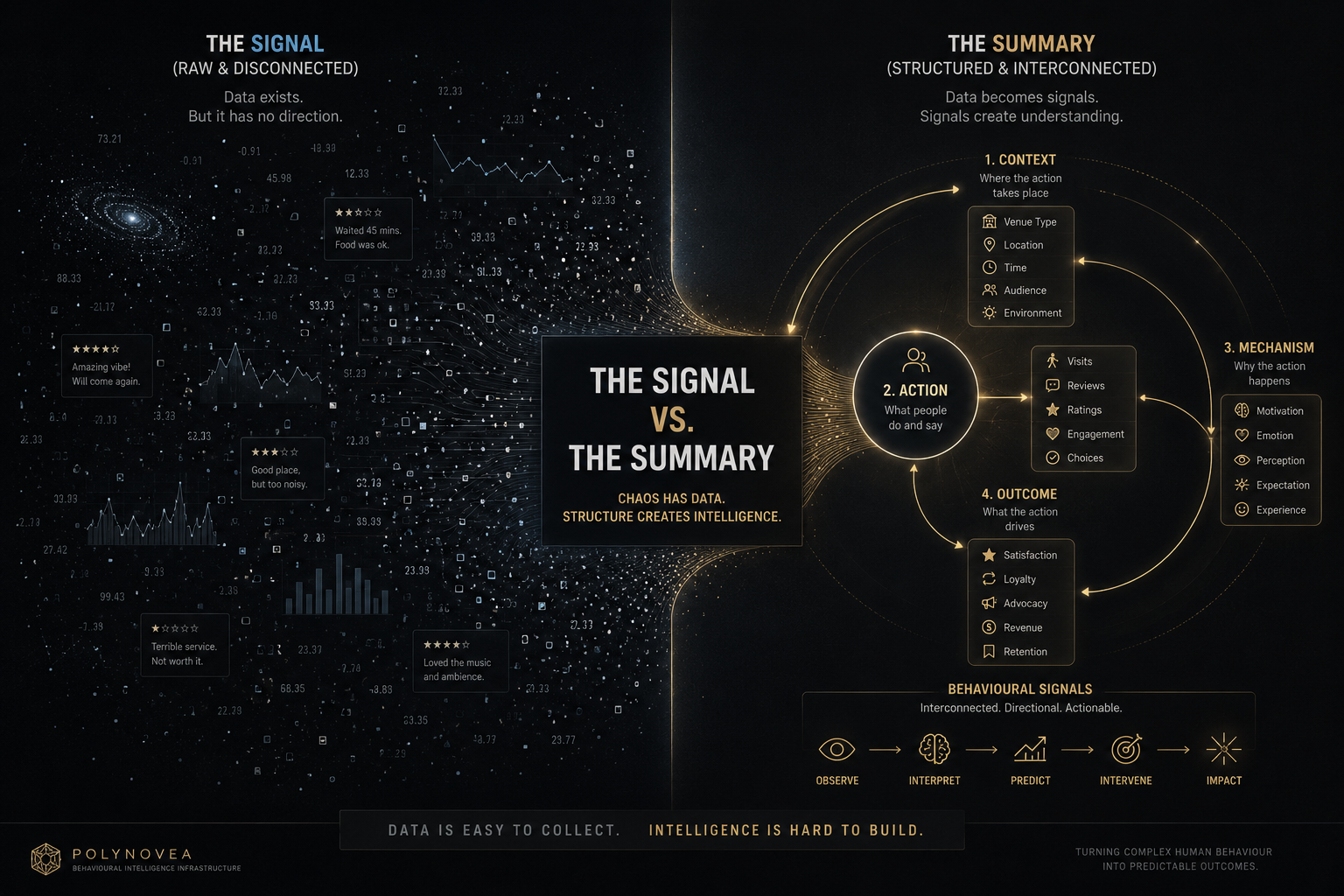
The unit of analysis in behavioural intelligence is not the person, the transaction, the review, or the rating. It is the behavioural signal: a specific, structured observation about what someone did, how they responded, and what triggered that response.
A behavioural signal has three necessary components. The action: what occurred, described with sufficient granularity to be distinguishable from other actions. The context: the conditions under which the action occurred, including preceding events and environmental factors. The mechanism: the interpretable link between context and action—not assumed, but observed or strongly inferable. Without all three, you have data. With all three, you have the foundation for intelligence.
Contrast this with the survey response. A rating of "4" has no action, no context, no mechanism. It is a number in search of meaning. Contrast it with the clickstream: abundant actions, thin context, absent mechanism. It describes what happened, not why it mattered.
The behavioural signal is constructed, not collected. It requires deliberate design of what to observe, how to structure observations, and how to validate interpretations. A retail organisation might structure observation of customer navigation, pause, interaction, and departure into interpretable signals. The cost of misconstructed signals is severe: false positives, spurious correlations, interventions that address the wrong mechanism.
What Makes Behavioural Intelligence Structurally Different
Against traditional analytics, behavioural intelligence occupies a different category. Analytics collapses data into summaries. Summaries are useful for monitoring but destructive for understanding mechanisms. The average obscures the distribution; the aggregate erases the relational structure that gives behaviour meaning. Analytics asks: "What happened?" Behavioural intelligence asks: "What is operating, and how do we know?"
Against sentiment analysis, the distinction is equally sharp. Sentiment analysis operates on language, not action. It classifies expression, not behaviour. The same sentiment can accompany radically different behaviours; the same behaviour can be described with opposite sentiments.
Against traditional research, behavioural intelligence insists on both generalisability and actionability through continuous, structured observation rather than periodic sampling. Research produces knowledge that decays; behavioural intelligence produces intelligence that updates.
The preservation of relational meaning is critical. Behaviour is contextual and interconnected. Behavioural intelligence maintains the structure between signals; analytics severs it. This enables a shift from descriptive to diagnostic: behavioural intelligence is not primarily interested in characterising what happened but in identifying what mechanisms are operating and whether they are stable. The same dataset yields different actionable outputs through analytics versus behavioural intelligence approaches. More data in analytics yields more precision around the same estimate; behavioural intelligence yields different, more specific intelligence.
The Compounding Property
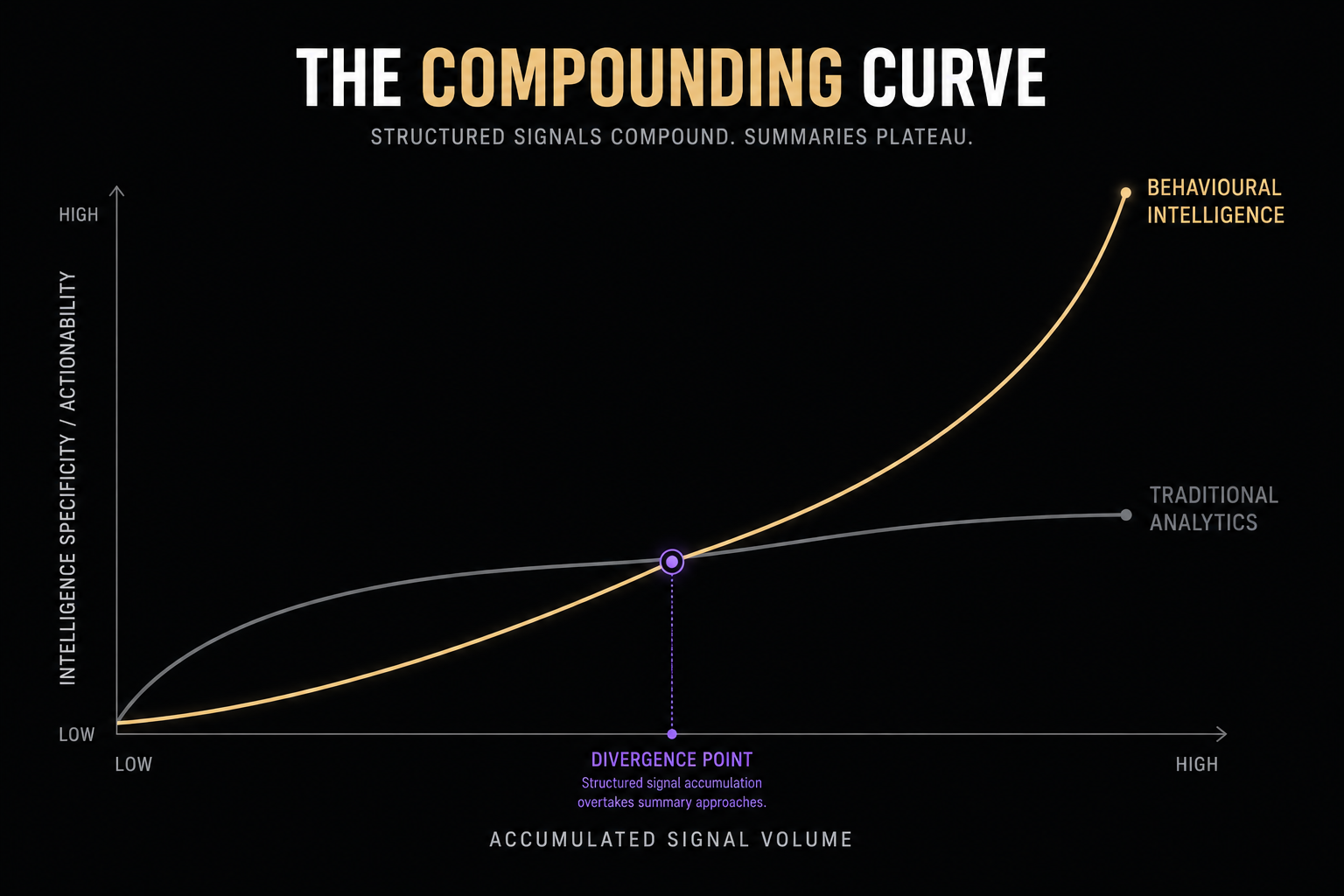
Traditional analytics produces the same type of output regardless of scale. More data tightens confidence intervals around the same parameters. The intelligence does not become more specific; it becomes more certain about the same level of generality.
Behavioural intelligence produces increasingly specific intelligence as data volume grows. More signals enable more precise characterisation of mechanisms. More contexts enable more valid boundary conditions for where mechanisms operate. More sequences enable more accurate prediction of how mechanisms unfold over time. The compounding is not merely quantitative. It is qualitative: the nature of the intelligence changes, becoming more differentiated and more actionable.
Early-stage behavioural intelligence identifies that a mechanism exists. Mid-stage behavioural intelligence characterises the conditions under which it operates and its typical magnitude. Mature-stage behavioural intelligence predicts individual-level variation, anticipates mechanism interaction, detects when a mechanism has shifted or decayed. Each new signal can validate, refine, or challenge the interpretation of existing signals. This network effect of signals creates increasing returns, distinct from the diminishing returns curve characteristic of traditional analytics.
What Becomes Possible
Mechanism-level intervention replaces symptom treatment. Instead of addressing low scores or high churn directly, organisations can address the operative behavioural mechanisms that produce them. Pre-emptive action becomes feasible: not merely predicting what will happen but identifying the conditions under which specific mechanisms activate, enabling prevention rather than reaction.
Validated learning at scale follows. Organisations can test whether interventions actually alter mechanisms, not just whether they move summary metrics. Intelligence durability accrues: accumulated, validated, structured intelligence becomes an organisational asset that persists beyond individual expertise.
The shift from "what works on average" to "what operates here, for this population, under these conditions" transforms resource allocation. The reduction of reliance on heroic individual interpretation; the institutionalisation of structured understanding. The protection against metric gaming: when the unit of analysis is the signal, not the summary, manipulation becomes more detectable.
Concrete scenarios illustrate what analytics cannot achieve: early intervention before churn, targeted support before disengagement, resource allocation based on mechanism activation rather than population averages.
The Discipline Required
Behavioural intelligence is not a platform, a dashboard, or an algorithm. It is a commitment to deliberate signal design, rigorous measurement validation, relational interpretation, and continuous updating as new signals accumulate. The organisations that succeed with behavioural intelligence treat it as a capability to build, not a tool to deploy.
The risk of misimplementation is substantial: treating behavioural intelligence as "advanced analytics" and applying it with analytics assumptions destroys its distinctive value. Signal design requires domain expertise and theoretical grounding; it cannot be fully automated. Interpretation requires human judgment structured by systematic method, not replaced by it. The compounding requires accumulation, which requires patience and sustained commitment.
The organisations that separate themselves over the next decade will not be those with the most data. They will be those with the most disciplined approach to extracting intelligence from it.
If your organisation is evaluating how to move beyond summary metrics toward structured behavioural intelligence, the first question is not what technology to adopt. It is whether you have defined your unit of analysis with sufficient rigour to ever build something that compounds. We publish on the methodological foundations of this discipline. Subscribe to receive subsequent pieces in this series.