The Difference Between Behavioural Intelligence and Sentiment Analysis
Sentiment Analysis Tells You What Happened. Behavioural Intelligence Tells You Why.
Sentiment Analysis Tells You What Happened. Behavioural Intelligence Tells You Why.
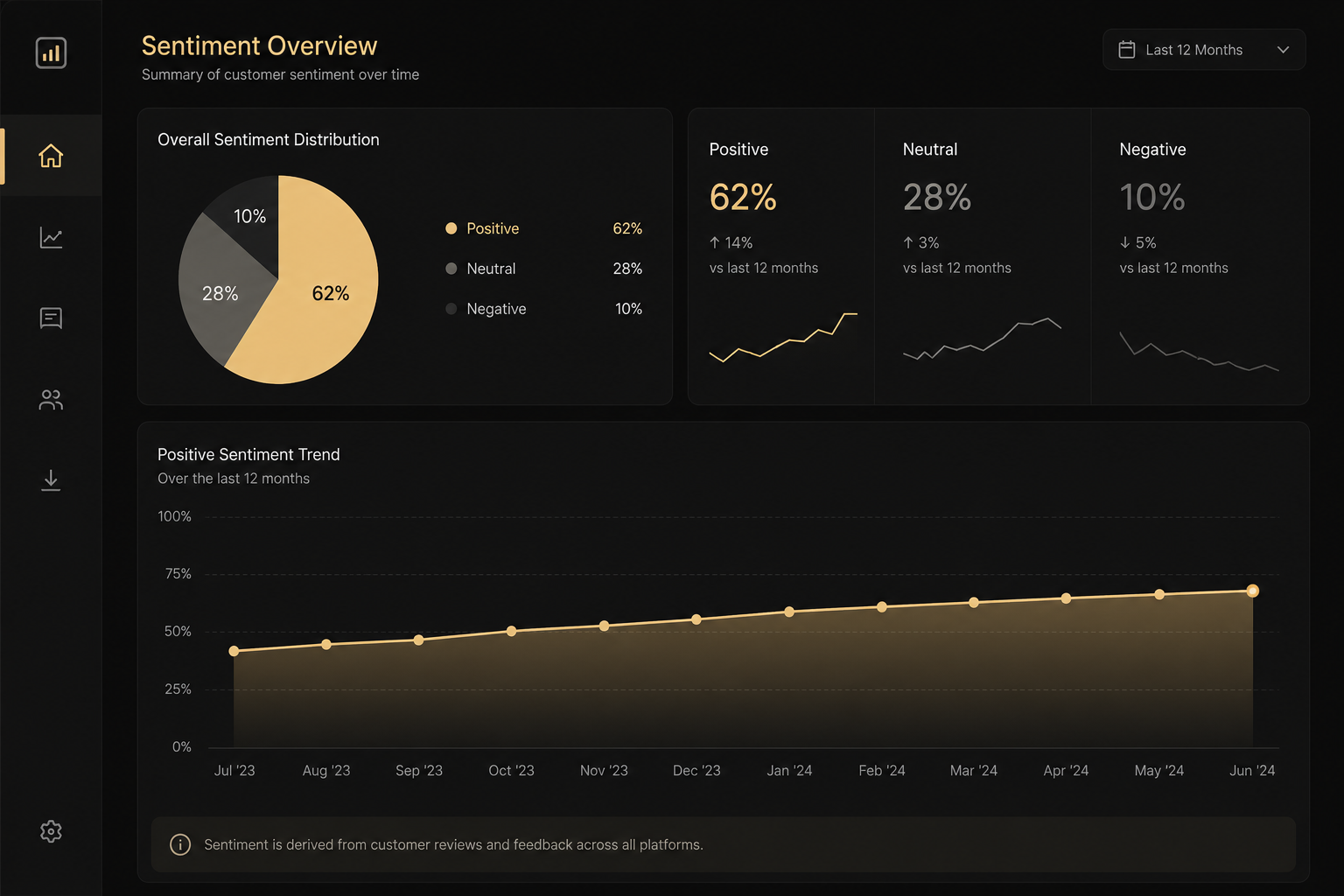
Every organisation with a digital footprint generates customer feedback at scale. Reviews, surveys, social mentions, support tickets—thousands of data points, each carrying an emotional charge. Sentiment analysis has become the default tool for making sense of this volume: automated systems that classify text as positive, negative, or neutral, then aggregate these labels into dashboards that leadership reviews quarterly.
The technology works as advertised. It processes language efficiently, applies consistent criteria, and produces trackable metrics. The problem is not that sentiment analysis fails at its task. The problem is that its task—classification—is structurally insufficient for the decisions organisations actually need to make.
Sentiment analysis answers "what was the valence?" It cannot answer "what caused it?" or "will it repeat?" or "what should we change?" These are mechanism questions, not classification questions. Organisations that mistake evaluative labels for explanatory models operate with a categorical blind spot. They see the score and miss the system.
This distinction matters for CX directors watching NPS programmes plateau, for data science leads building insight infrastructure, for strategy officers evaluating technology investments, and for operations managers who need to translate feedback into specific, testable changes. Sentiment and behavioural intelligence are not competitors. They are different instruments for different questions. Understanding when each applies—and why conflating them produces strategic harm—is the subject of this analysis.
The Honest Capabilities of Sentiment Analysis
Sentiment analysis, at its core, is a natural language processing task: supervised learning models or lexicon-based systems that assign categorical labels to text, often with confidence scores. "Great service" becomes {positive: 0.97}. "Wait was too long" becomes {negative: 0.84}. The technical achievement is real. Commercial systems process thousands of reviews in minutes, apply identical criteria across all inputs, and render the results in interfaces that leadership understands immediately.
The legitimate strengths deserve acknowledgment. Sentiment analysis enables trend monitoring over time—whether customer perception is improving or deteriorating. It supports competitive benchmarking when applied to review corpora across market players. It functions as an early-warning system, flagging negative spikes for human investigation. It is relatively inexpensive to implement and scale. These are not trivial contributions.
Most commercial deployments follow predictable patterns: social media monitoring for brand health, post-interaction survey analysis, review aggregation dashboards, and NPS open-text coding. The operational appeal is obvious. Leadership values dashboards with green, yellow, and red indicators. Sentiment delivers this efficiently.
The trap emerges from the implicit promise. Because sentiment is measurable and trackable, it is mistaken for actionable. Because it produces numbers, it is treated as intelligence. Because it answers "how do customers feel?" it is assumed to illuminate "why do they behave as they do?" These are separate questions. Sentiment analysis contains no causal architecture. It classifies outcomes without touching mechanisms. The boundary is not a limitation of current technology but a structural feature of the approach itself.
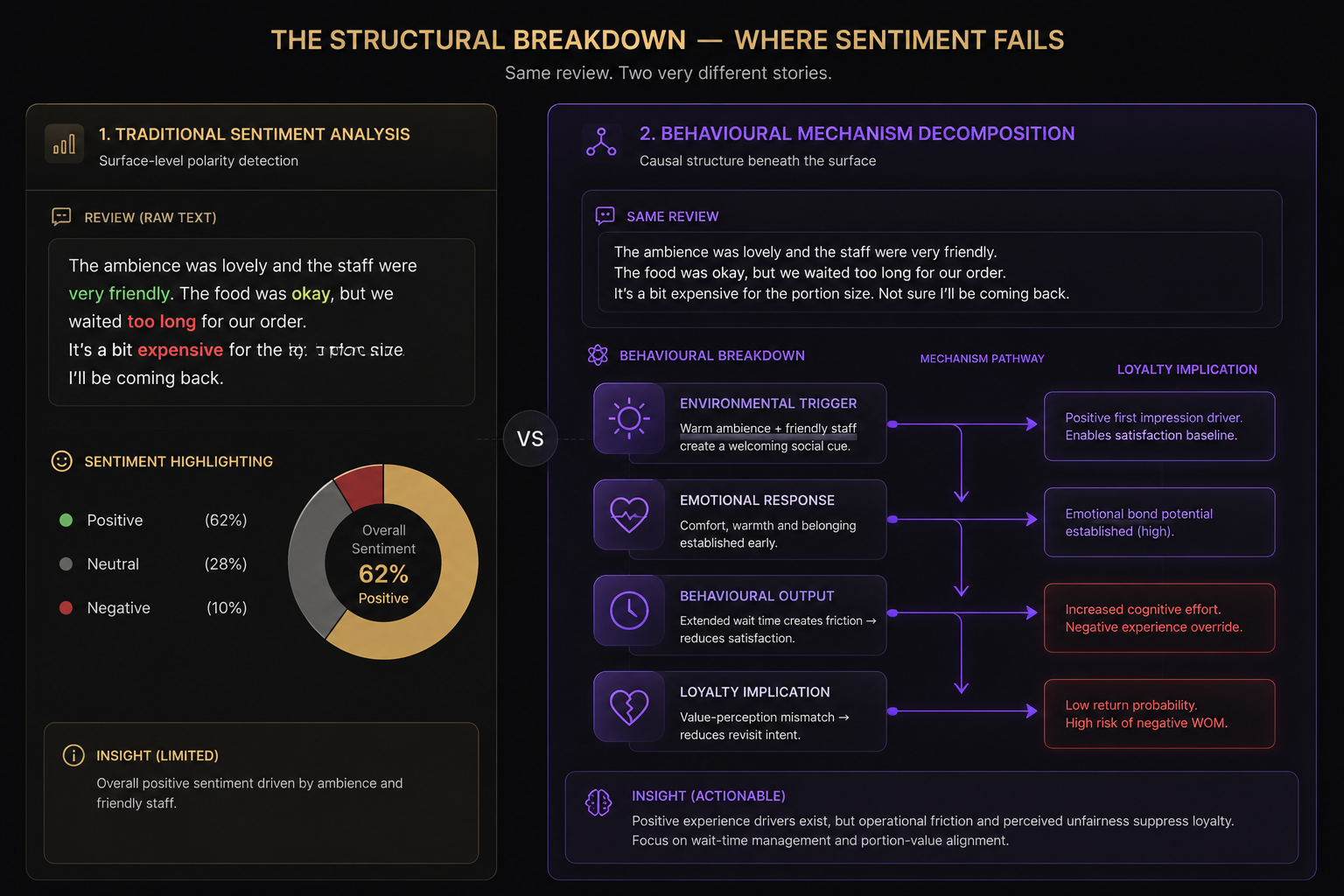
The Structural Breakdown — Where Sentiment Fails
Sentiment analysis fails not in execution but in scope. Five structural limitations make it categorically insufficient for operational decision-making.
The "Why" Gap
Sentiment cannot distinguish causes of identical scores. A five-star review motivated by social belonging and a five-star review motivated by transactional efficiency receive identical classifications. The business cannot replicate what it cannot distinguish. Two customers express equal satisfaction; their behavioural futures diverge dramatically. Sentiment flattens this difference.
The Event vs. Judgment Confusion
A restaurant visit is not a judgment. It is a sequence of environmental inputs, behavioural responses, and psychological states. Sentiment captures only the retrospective evaluation, missing the behavioural event entirely. Measuring only the final sentiment is akin to recording only the final score of a chess game, not the moves that produced it.
The Signal Relationship Blindness
Two keyword detections—"live music" and "stayed three hours"—remain unconnected in sentiment systems. Yet the relationship between signals, not the signals themselves, often constitutes the actionable intelligence. Revenue implications flow from behavioural sequences, not isolated mentions.
The Contradiction Problem
Mixed sentiment—half praise for energy, half complaint about noise—registers as measurement noise or "mixed." This is actually a structurally split behavioural signal, diagnostically rich, not a failure to resolve. Sentiment averages this tension away; intelligence requires preserving it.
The Predictive Void
Sentiment scores describe past states. They contain no mechanism for projecting future behaviour. Will the customer return? Will they bring others? Will they pay more? Sentiment has no architecture for these questions. It monitors; it does not forecast.
These limitations are not bugs to be fixed by better algorithms. They are consequences of treating classification as explanation.
Same Star Rating, Different Behavioural Events
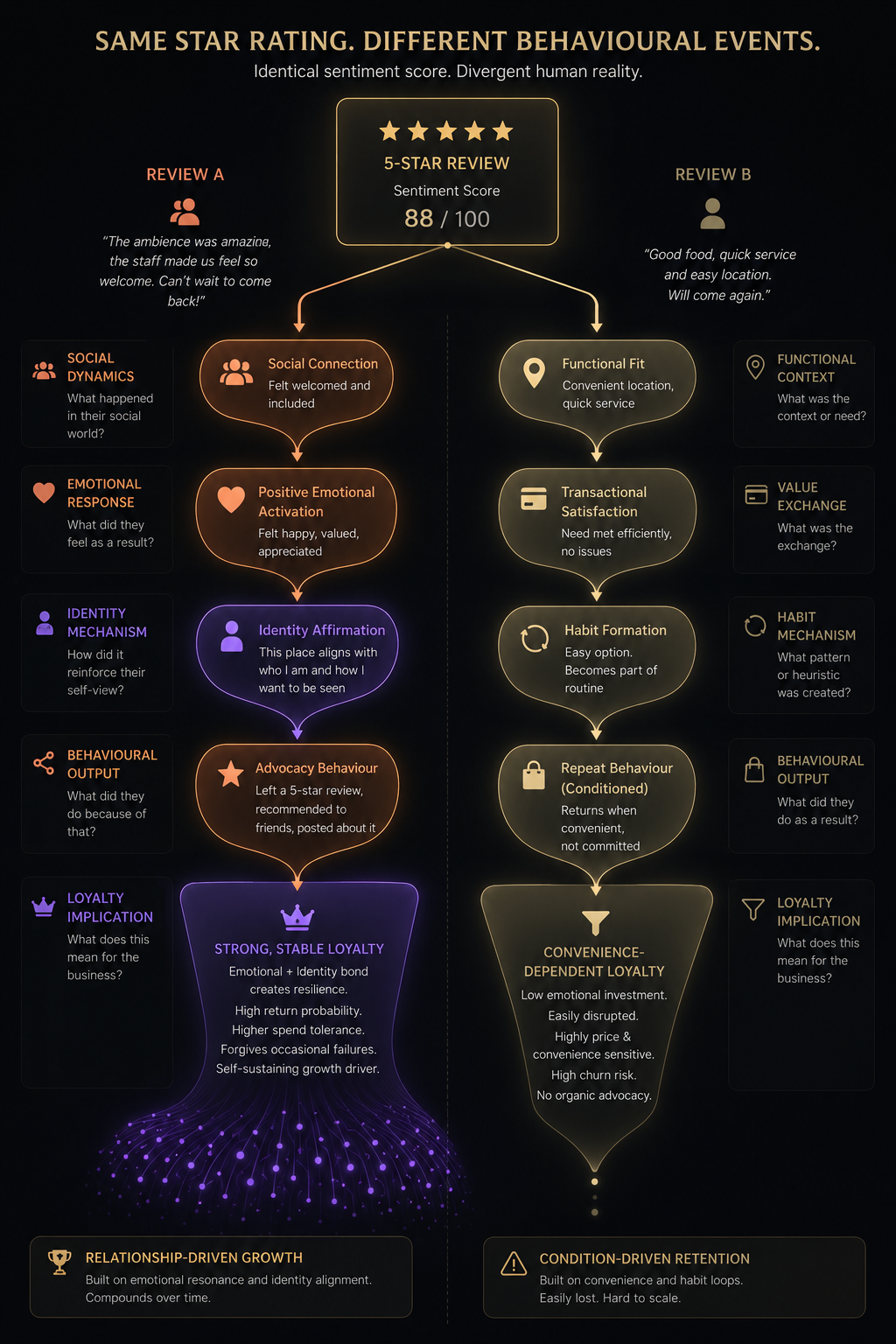
The abstract becomes concrete through example. Consider two five-star reviews for the same restaurant, both captured by sentiment analysis as "positive, high confidence."
**Review A:** "Finally found my place. The staff remembered my name from last time. Sat at the bar, talked to Maria.toml for an hour. This is where I belong."
Sentiment output: Positive (0.94 confidence).
Behavioural decomposition: Identity mechanism activated → social recognition → belonging → place attachment → repeat visitation with high lifetime value, potential advocacy, price inelasticity.
**Review B:** "In and out in 45 minutes. Order was correct, food was fine. Exactly what I needed."
Sentiment output: Positive (0.94 confidence).
Behavioural decomposition: Habit mechanism activated → efficiency → satisfaction with low friction → conditional repeat (competitive environment sensitive), price sensitive, low advocacy probability.
The divergence is stark. Same sentiment score; diametrically opposed operational implications. Review A demands investment in staff continuity, community programming, recognition systems. Review B demands investment in speed, accuracy, convenience infrastructure. Sentiment analysis prescribes the same response to both: "do more of whatever made them positive." This is not guidance; it is a category error with budgetary consequences.
The compound error aggregates these into "satisfied customers," averaging their predicted lifetime value. The strategic danger optimises for sentiment score improvement without mechanism-level understanding. Organisations pursuing higher ratings without distinguishing mechanisms invest blindly, often reinforcing the wrong systems for the wrong segments.
What Behavioural Intelligence Captures That Sentiment Cannot
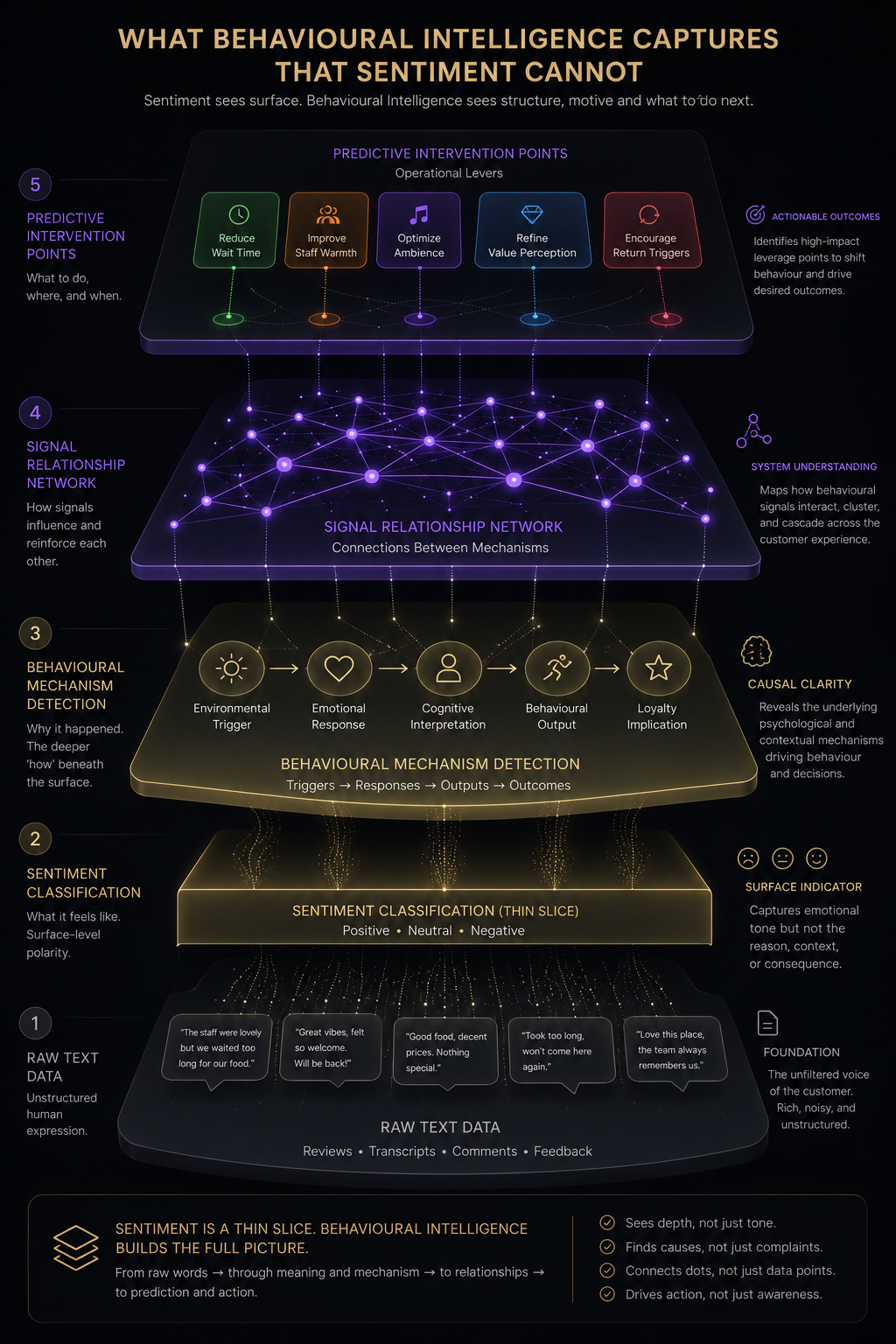
Behavioural intelligence is not sentiment analysis with better marketing. It is a different conceptual framework answering different questions. Four capabilities distinguish it.
**Mechanism Identification.** Not "was it positive?" but "what psychological mechanism was activated?" Identity, habit, exploration, restoration, status, reciprocity—each mechanism carries distinct operational implications and intervention points. Knowing that a customer is "positive" tells you little. Knowing that they are positive because of identity attachment tells you whom to assign as their server, what seating to prioritise, how to recognise them on return.
**Signal Relationship Mapping.** Detecting co-occurrence patterns that indicate causal or reinforcing structures. "Live music" + "extended dwell" + "higher spend" = environmental trigger mechanism. The intelligence is in the relationship, not the individual mentions. Sentiment systems see words; behavioural intelligence sees structure.
**Contradiction Preservation.** Mixed signals are not noise to average away but diagnostic data to investigate. Energy/noise tension indicates a design tradeoff, not a measurement failure. Resolution requires understanding who each experience serves, not forcing consensus. Sentiment flattens; intelligence preserves.
**Predictive Structure.** Behavioural mechanisms have known propensity patterns. Identity-driven customers exhibit different future behaviours than habit-driven ones. This enables proactive intervention, not just reactive monitoring. The organisation can anticipate, not merely record.
The epistemological difference is fundamental. Sentiment analysis operates from an epistemology of classification: what category? Behavioural intelligence operates from an epistemology of mechanism: what caused this, and under what conditions will it recur? These are not incremental improvements. They are different kinds of knowledge.
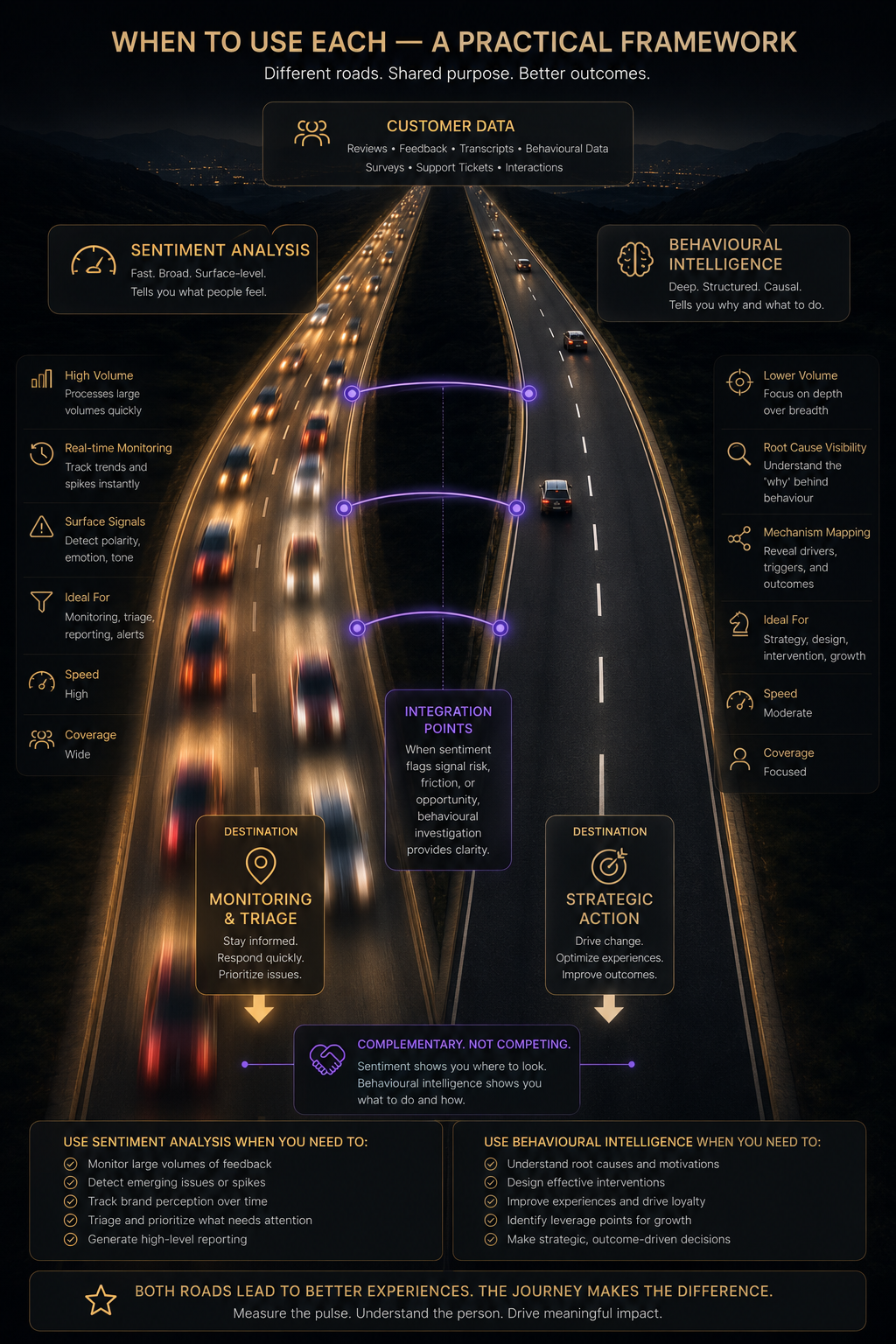
When to Use Each — A Practical Framework
The frameworks are complementary, not competitive. The error is using sentiment for intelligence work, not using sentiment at all.
Appropriate for Sentiment Analysis: High-volume monitoring where directional awareness suffices. Early-warning systems—sentiment drops below threshold, investigate. Benchmarking against competitors on generic satisfaction. Situations where speed and cost dominate depth requirements. Regulatory or reputational risk scanning.
Appropriate for Behavioural Intelligence: Strategic investment decisions where capital allocation depends on understanding causation. Customer segmentation that needs to predict behaviour, not just describe attitude. Experience design and redesign—what to change, not just whether changes worked. Revenue optimisation—which mechanisms drive spend, frequency, advocacy. Organisational learning—building institutional knowledge about what works for whom.
The Integration Model: Sentiment functions as sentinel: rapid, broad, surface-level. Behavioural intelligence functions as analyst: slower, deeper, mechanism-level. Most organisations cannot afford deep analysis on every data point. The tiered approach applies sentiment for triage, behavioural intelligence for strategically selected cases. Sentiment flags; intelligence investigates.
Organisations typically over-rely on sentiment early, then build behavioural capability as competitive pressure increases. The maturity curve is predictable. The question is where on that curve your organisation sits, and whether your current tooling matches your actual decision needs.
Conclusion — The Question You Are Actually Trying to Answer
The structural distinction bears repeating. Classification versus mechanism. Evaluation versus event. Monitoring versus understanding. These are not semantic quibbles. They determine what organisations see and what they can do.
The diagnostic question for leaders: "When I look at my customer insights, what decisions can I actually make from what I see?"
If the answer is "track whether things are getting better or worse," sentiment suffices. If the answer is "know what to change and for whom," sentiment is structurally inadequate. The honest assessment is that many organisations are paying for intelligence and receiving classification.
The gap between what sentiment promises and what it delivers is not a technology failure. It is a category error. Correcting it requires not better sentiment algorithms but a different conceptual framework. Behavioural intelligence is that framework—not because it is more sophisticated, but because it answers different, more operationally relevant questions.
The organisations that recognise this distinction and build accordingly will allocate capital more precisely, design experiences more effectively, and develop customer relationships that compound over time. Those that do not will continue optimising scores while their competitors optimise systems.
Assess Your Insight Architecture
Three diagnostic questions for your current customer insight workflow:
1. Can you distinguish why a positive review was positive? 2. Can you predict which positive reviewers will return? 3. Can you map specific operational changes to specific behavioural outcomes?
If any answer is no, the gap between your current system and operational intelligence is measurable—and addressable.